

The Milwaukee M18 2848-20 is a tire-focused cordless inflator built for drivers who want faster pressure corrections than a compact emergency pump can usually provide. Its strongest use cases are passenger cars, SUVs, pickups, work vehicles, and trailers—especially when the owner already has M18 batteries.
During use, the main advantage was not the headline 150 PSI rating. It was the combination of strong airflow, simple controls, automatic pressure checking, and a stable design that makes routine tire maintenance less frustrating.
The trade-off is price and size. The standard 2848-20 is normally sold without a battery or charger, and the tool is too bulky for most gloveboxes. It also lacks the high-volume inflation and deflation functions found on more versatile models.
Quick Verdict
The Milwaukee M18 2848-20 is worth buying for existing M18 owners who regularly maintain several vehicles or larger tires.
It is fast, straightforward to use, and better suited to repeated car and light-truck tire top-offs than small rechargeable inflators. The TrueFill system pauses to stabilize and recheck pressure before shutting off, while four memory settings make it convenient for households with multiple vehicles or different front and rear tire pressures.
I would choose it for routine tire maintenance, pickup and SUV use, trailers, and service vehicles. I would skip it for occasional emergency-only use, large air mattresses, or situations where 12V vehicle power is essential.
Best for: Existing M18 owners, multi-vehicle households, pickup and SUV owners, contractors, and trailer users.
Skip it if: You want the least expensive emergency inflator, need glovebox storage, or primarily inflate mattresses and rafts.
Pros and Cons
Pros:
- Fast tire top-offs
- Automatic pressure checking and shutoff
- Four pressure-memory settings
- Secure brass threaded chuck
- Long 36-inch hose
- Onboard hose and accessory storage
- Compatible with Milwaukee M18 batteries
- Five-year tool warranty
Cons:
- Battery and charger normally sold separately
- Larger than compact emergency pumps
- Threaded chuck takes longer to remove
- A small amount of air may escape during disconnection
- No high-volume inflation or deflation mode
- Automatic target pressure cannot be set below 10 PSI
- Extended operation requires cooling time
- No 12V or AC backup power
Milwaukee M18 2848-20 Specifications
| Specification | Milwaukee 2848-20 |
|---|---|
| Battery platform | Milwaukee M18 |
| Rated voltage | 18V DC |
| Maximum pressure | 150 PSI |
| Air output at 0 PSI | 1.41 SCFM |
| Air output at 35 PSI | 1.10 SCFM |
| Pressure units | PSI, bar, and kPa |
| Hose length | 36 inches |
| Pressure memories | Four |
| Automatic-stop minimum | 10 PSI |
| Recommended operating temperature | 0°F to 125°F |
| Warranty | Five years |
| Package type | Bare tool |
| Included adapters | Presta adapter, inflation needle, inflator nozzle |
The 150 PSI maximum confirms that the pump can develop substantial pressure, but it does not tell you how quickly it will fill a large tire. Inflation speed also depends on airflow at the working pressure, tire volume, starting pressure, target pressure, battery condition, and temperature.
For ordinary car and light-truck use, the listed 1.10 SCFM output at 35 PSI is more meaningful than the maximum-pressure figure. It better reflects the conditions under which many drivers will use the inflator.
Milwaukee says the tool can top off a 33-inch light-truck tire in under one minute. That should be understood as a manufacturer claim about a pressure correction, not a promise to fill an empty 33-inch tire in less than 60 seconds.
What Comes in the Box?

The standard Milwaukee 2848-20 package includes:
- The inflator
- Integrated 36-inch hose
- Brass threaded Schrader chuck
- Presta valve adapter
- Sports-ball needle
- General inflator nozzle
- Onboard hose and accessory storage
The standard package normally does not include:
- M18 battery
- M18 charger
- Carrying case
- Quick-release tire chuck
Retailers sometimes sell promotional bundles, so check the package description carefully. A product image showing a battery does not always mean the battery is included.
Practical Hands-On Experience
Setup and Controls
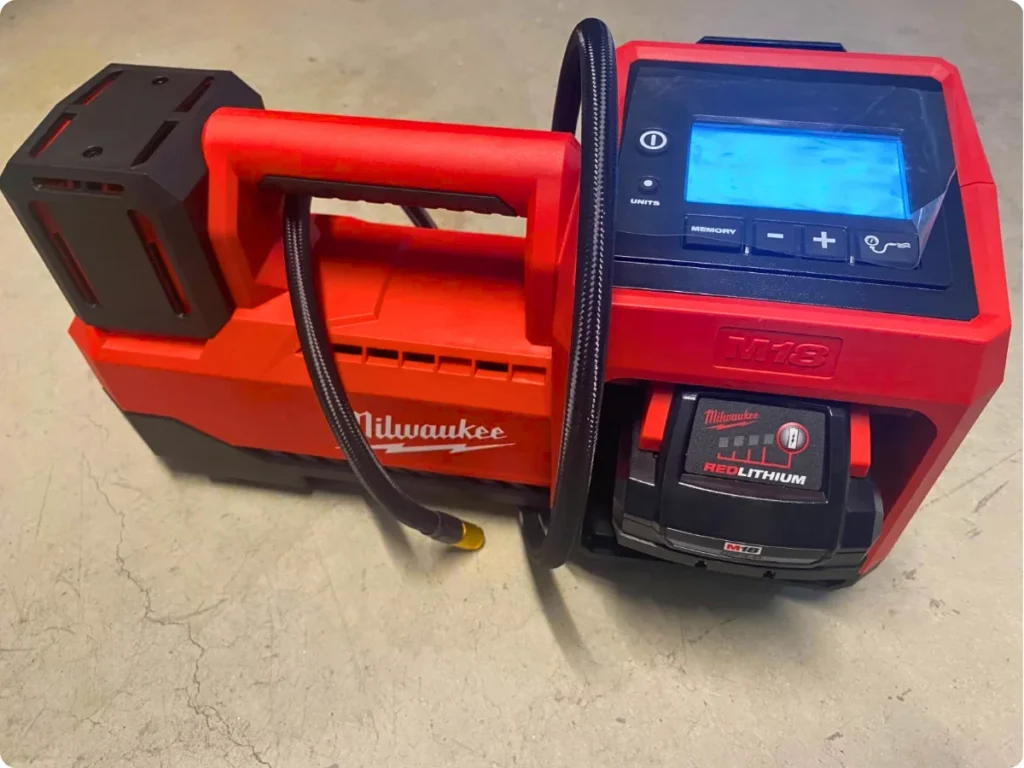
Setup is straightforward. Install an M18 battery, press the power button, select PSI, bar, or kPa, set the target pressure, connect the chuck, and start inflation.
The control panel is easier to understand than the tiny interfaces used on many compact inflators. Current pressure and target pressure are displayed separately, so there is little confusion about what the machine is reading and where it intends to stop.
The tool also shuts down after a period of inactivity, helping reduce unnecessary battery drain between tires.
TrueFill Automatic Pressure Checking
Milwaukee calls its automatic pressure-check system TrueFill. The inflator pumps air, pauses to allow pressure to stabilize, checks the reading, and resumes when the tire remains below the selected target.
The pause may initially look as though the machine has stopped too early. In practice, it is part of the control process.
Pressure can temporarily appear higher while air is moving through the hose and valve. Allowing that pressure to settle before making another decision reduces the chance of stopping based on a momentary spike.
The system may repeat this inflate-pause-check sequence several times. Once the selected pressure is reached, the pump shuts off automatically.
Automatic shutoff is convenient, but it does not remove the need to remain nearby. A portable compressor should not be left unattended while connected to a tire or inflatable item.
Four Pressure Memories
The four memory settings are genuinely useful for repeated maintenance.
A household can save pressures for two vehicles. A pickup owner can keep separate settings for the truck and trailer. Drivers with different front and rear tire specifications can also avoid repeatedly entering the same numbers.
The memories store target pressures only. They do not change the tool’s operating limits or make automatic mode appropriate for every low-pressure item.
Hose and Brass Chuck
The 36-inch hose provides enough reach to place the inflator securely beside the wheel rather than balancing it against the tire. It is long enough for normal car and pickup use without becoming difficult to store.
The brass Schrader chuck screws directly onto the valve stem. This produces a secure seal and reduces the chance of the hose popping loose while the compressor is running.
The compromise is removal. A threaded chuck takes longer to disconnect than a lever-style fitting, and a brief hiss of escaping air is common while it is being unscrewed.
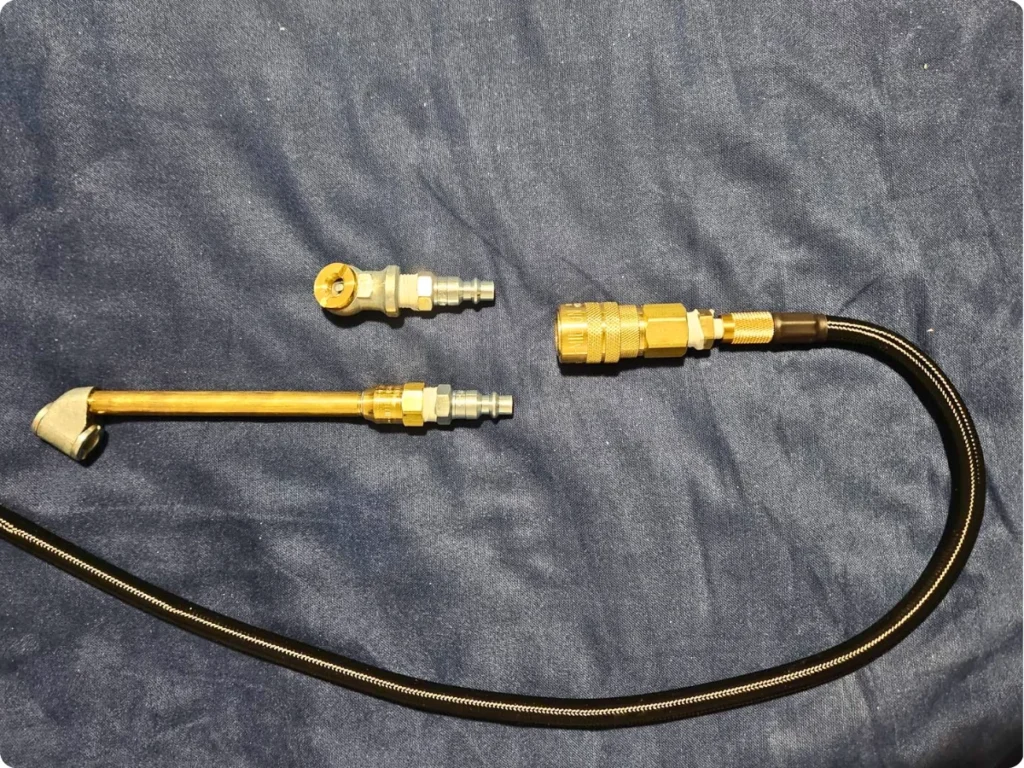
I would not assume that every brief release means the inflator stopped inaccurately. Remove the chuck promptly without pulling sideways on the valve stem, then verify the tire with a separate gauge when precision matters.
Portability and Storage
The 2848-20 is portable, but it is not a small emergency inflator.
Its wide body, carry handle, hose storage, and removable battery make it better suited to a garage shelf, cargo area, truck box, or service vehicle than a glove compartment.
The larger footprint has an advantage during use. The tool feels stable beside a tire and is less likely to tip or move around than a narrow handheld unit.
The adapters store on the tool, which reduces the chance of leaving the Presta fitting or inflation needle behind. I would still inspect the storage area periodically if the inflator travels loose in a work truck.
Inflation Speed and Performance
The Milwaukee M18 2848-20 is strongest when correcting tires that are several PSI low. That is where its airflow and battery platform provide a noticeable advantage over many compact rechargeable pumps.
Instead of connecting a 12V cord, starting the vehicle, or waiting on a small built-in battery, you install an M18 pack, choose the target pressure, and let the automatic system finish the job.
Cars and SUVs
For passenger vehicles, the 2848-20 provides more capacity than many drivers strictly need. That becomes valuable when several tires require attention or when the household maintains more than one vehicle.
The practical benefit is not only speed. A quicker inflator makes it less tempting to fix only the visibly low tire and ignore the other three.
Always inflate vehicle tires to the recommended cold pressure shown on the door-jamb placard or in the owner’s manual. The maximum pressure molded into the tire sidewall is not the normal operating target for most vehicles.
Pickup and Light-Truck Tires
Large pickup tires contain considerably more air than passenger-car tires. The Milwaukee remains well suited to them, particularly for normal pressure restoration, but the exact inflation time depends on the tire and conditions.
A modest top-off on a 33-inch tire is a different task from filling the same tire from nearly flat. Tire width, construction, internal volume, starting pressure, target pressure, battery, and ambient temperature all affect the result.
Independent F-150 Benchmark
Pro Tool Reviews published a test in which six PSI was removed from a 2015 Ford F-150 tire before several cordless inflators returned it to 36 PSI.
| Inflator | Published inflation time | Independently checked pressure |
|---|---|---|
| Milwaukee M18 2848-20 | 52 seconds | 36 PSI |
| Ridgid R87044 | 1 minute 19 seconds | 35 PSI |
| Ryobi P747 | 2 minutes 19 seconds | 35 PSI |
This is useful evidence that the Milwaukee can be both quick and accurate under the disclosed conditions. It should not be treated as a universal ranking for every tire, battery, temperature, or pressure range.
Can It Inflate a Nearly Flat Tire?
Yes, the Milwaukee can add substantial air to a low tire, but a deep refill takes much longer than a routine top-off.
Longer inflation cycles also create more heat and use more battery capacity. That makes the tool’s cooling instructions more relevant.
An inflator cannot repair:
- A puncture
- Sidewall damage
- Internal tire separation
- A damaged valve
- A bent wheel
- Damage caused by driving on a flat tire
Adding air does not automatically make a damaged tire safe to drive.
The 2848-20 is also not a replacement for a shop compressor when a tire bead must be seated. Bead seating may require a rapid burst of high-volume air that portable tire inflators are not designed to provide.
Pressure Accuracy and TrueFill Performance
Does It Stop at the Correct PSI?
The automatic pressure-check system is one of the strongest reasons to choose this model.
During use, the inflate-pause-check sequence felt deliberate rather than erratic. It reduced the need to stop manually and check the tire several times.
Milwaukee states that the pressure system is designed to deliver accuracy within approximately 1 PSI compared with a standard gauge. In the independent F-150 test, a 36 PSI target also measured 36 PSI on the separate reference gauge.
A separate tire-pressure gauge is still useful. It can help determine whether an unexpected reading comes from the inflator, a leaking valve, air released during disconnection, temperature change, or the reference gauge itself.
Does the Threaded Chuck Lose Pressure?
A small amount of air can escape while the chuck is being removed. The amount depends on removal speed, valve-core condition, and tire volume.
The effect is generally less noticeable on a large vehicle tire than on a bicycle tire. Small-volume tires can change pressure quickly, which is one reason manual control is more appropriate for bicycles and similar items.
Re-Zeroing the Display
Milwaukee documents a re-zero procedure for situations where the display reads above zero while nothing is connected.
With the hose disconnected, hold the minus button and inflation button together for approximately three seconds. The procedure can correct a zero deviation of up to 5 PSI.
This is a zero adjustment, not a repair for a failing pressure sensor. Contact Milwaukee service when a meaningful error continues or exceeds the documented correction range.
Battery Runtime and the Best M18 Battery
There is no single reliable “tires per charge” figure for the Milwaukee M18 inflator.
Runtime depends on:
- Battery capacity
- Battery age and condition
- Tire size
- Starting pressure
- Target pressure
- Ambient temperature
- Number of consecutive inflation cycles
Is a 2.0Ah Battery Enough?
A compact 2.0Ah M18 battery is a practical pairing for occasional passenger-car top-offs. It keeps the tool lighter and is easy to store with the inflator.
I would be less comfortable relying on a small pack for repeated pickup-tire corrections, trailer work, or a deep refill. The tool may still operate normally, but the available energy reserve is lower.
Best All-Round Battery
For most users, an M18 XC 5.0Ah battery is the most practical balance of capacity, size, and availability.
It provides more reserve for several vehicles or larger tires without making the inflator unnecessarily bulky.
This is practical guidance rather than a promise of a specific tire count. Battery age, tire volume, temperature, and pressure change can alter the result considerably.
Is a High Output Battery Necessary?
A High Output battery is not required simply because the inflator accepts one.
A larger pack may provide more usable energy and may support demanding operation better, but battery compatibility alone does not prove that inflation time will improve.
For normal car and SUV maintenance, I would use a healthy M18 pack already available rather than buying a premium battery specifically for this tool.
For roadside use, the most important battery specification is often whether the pack is charged. Check it periodically rather than assuming a battery stored for months is ready.
Noise, Heat, and Continuous-Use Limits
Cordless tire inflators are not quiet. The Milwaukee produces the mechanical compressor sound expected from a portable high-pressure pump.
Its noise has been described by independent reviewers as lower-pitched than several competing inflators, but it should not be purchased with the expectation of quiet operation.
The practical advantage is that many routine top-offs finish quickly.
The cooling fan may continue running after the pump stops. That can be normal while the compressor head is cooling and does not necessarily indicate a fault.
Milwaukee provides two important heat instructions:
- If the temperature-protection indicator appears, allow the tool to cool for at least 10 minutes.
- After 20 minutes of continuous operation, allow 40 minutes of cooling.
Normal corrections across four passenger-vehicle tires may not approach 20 minutes of uninterrupted pumping. Deeply underinflated truck tires, several trailers, and fleet work are more likely to make the duty-cycle limit relevant.
Keep the ventilation openings clear and place the inflator on a stable surface. Do not bury it under cargo or restrict airflow while it is operating.
What Can the Milwaukee 2848-20 Inflate?
Cars and SUVs
Cars and SUVs are the inflator’s strongest use case. It has enough airflow to complete normal pressure corrections quickly, while automatic pressure checking helps reduce overshoot.
Pickups and Light-Truck Tires
The 2848-20 is a strong choice for light-truck tire maintenance. It is particularly useful for regular top-offs and pressure adjustments.
A deeper refill will take longer and consume more battery energy. Tire diameter alone does not determine the workload; width, construction, volume, starting pressure, and target pressure all matter.
Trailer and RV Tires
The 150 PSI maximum provides sufficient pressure range for many trailer applications, but it does not guarantee fast inflation of every large tire.
Verify the correct cold pressure for the specific tire and vehicle before beginning. Large RV tires or several high-pressure trailer tires may push the tool closer to its documented continuous-use limits.
Bicycle Tires and Presta Valves

Milwaukee includes a Presta adapter.
Manual operation is the safer approach for bicycle tires because their small volume allows pressure to rise quickly. The automatic target cannot be set below 10 PSI, so low-pressure bicycle tires and similar items must be controlled manually.
Stay beside the tire and watch the pressure continuously.
Sports Balls and Small Inflatables
The included needle works with sports balls, while the tapered nozzle suits some small inflatable items.
Use manual mode and stop when the item reaches its documented pressure or appropriate firmness.
Air Mattresses and Large Inflatables
The Milwaukee is a high-pressure tire inflator rather than a high-volume blower.
It may inflate some small items, but it is inefficient for air mattresses, rafts, and large pool inflatables. A dedicated high-volume inflator and deflator is faster and normally includes more suitable hose fittings.
Common Milwaukee M18 Inflator Problems
The Inflator Will Not Turn On
Check the basics first:
- Confirm that the M18 battery has charge.
- Remove and firmly reinstall the battery.
- Inspect the contacts for dirt or damage.
- Try a known-good M18 battery.
- Check whether the battery or tool is outside its operating-temperature range.
An excessively hot or cold battery may activate protection and prevent normal operation.
It Pauses Before Reaching the Target
This can be normal.
TrueFill stops to let pressure stabilize, checks the reading, and resumes when needed. The sequence may repeat several times before the tire reaches the selected pressure.
The Temperature Indicator Appears
Stop inflation and allow the tool to cool for at least 10 minutes.
Move it away from heat, clear the ventilation openings, and avoid immediately beginning another long inflation cycle.
The Overload Indicator Appears
Restricted airflow may activate overload protection.
Check for:
- A kinked hose
- Blocked accessory
- Poorly seated chuck
- Obstructed valve
- Damaged valve core
- Another restriction in the airflow path
The Fan Keeps Running
The fan may continue after inflation while the pump head cools. This is normally expected behavior rather than automatic evidence of a fault.
The Final Pressure Seems Incorrect
Let the tire stabilize and check it with a dependable separate gauge.
Also consider:
- Air released while removing the chuck
- A leaking valve core
- An inaccurate reference gauge
- A display that needs to be re-zeroed
- Pressure changes caused by tire temperature
Seek service when a meaningful error remains repeatable.
Automatic Mode Will Not Accept Less Than 10 PSI
The automatic target has a 10 PSI minimum. Use manual mode for lower-pressure items and remain with the inflator throughout the process.
Milwaukee M18 2848-20 vs Other Tire Inflators
The Milwaukee M18 2848-20 is one of the strongest tire-focused options in our Best Tire Inflators guide, but another design may suit buyers who prioritize smaller storage, lower cost, or alternative power sources.
Milwaukee M18 vs Milwaukee M12 Inflator
The Milwaukee M12 inflator is smaller and easier to store. It makes sense for buyers already invested in the compact M12 battery platform and primarily maintaining passenger-car tires.
The M18 is the better choice for larger tires, repeated top-offs, and users who value speed more than compact storage.
Milwaukee M18 2848-20 vs DEWALT DCC020IB
The DEWALT DCC020IB is more versatile. It supports battery operation, 12V vehicle power, and AC power with the appropriate connection. It also includes high-pressure and high-volume functions, plus deflation capability.
The Milwaukee is more focused on fast tire maintenance. I would choose it when tires are the main job and M18 batteries are already available.
The DeWalt is a better fit when backup power options, mattress inflation, deflation, and broader household use matter more.
See the full Milwaukee M18 2848-20 vs DEWALT DCC020IB comparison for a more detailed breakdown.
ETENWOLF Vortex S6 vs Milwaukee M18 2848-20
The ETENWOLF Vortex S6 is a self-contained rechargeable inflator. It suits buyers who do not want to carry a separate power-tool battery.
The Milwaukee is the stronger fit for established M18 users and repeated vehicle-tire maintenance. The ETENWOLF is easier to treat as a standalone portable appliance.
Our ETENWOLF Vortex S6 vs Milwaukee M18 2848-20 comparison covers the differences in battery design, portability, tire capability, and buyer fit.
Other Compact Alternatives
Buyers prioritizing smaller storage or a self-contained rechargeable design may also consider:
- NOCO AIR20
- CRAFTSMAN CMCE520B
- Fanttik X10 Pro
- GOOLOO A3
- AstroAI AIRUN H
- VIAIR 88P 00088
Relevant comparisons include:
- NOCO AIR20 vs VIAIR 88P 00088
- Fanttik X10 Pro vs AstroAI AIRUN H
- GOOLOO A3 vs NOCO AIR20
These alternatives are most relevant to readers who have not committed to a power-tool battery platform.
Price, Warranty, and Overall Value
Value for Existing M18 Owners
The 2848-20 is easiest to justify when compatible batteries and a charger are already in the garage.
You can buy the bare tool and add a capable inflator without entering another battery system. For multi-vehicle households, pickup owners, contractors, and trailer users, the convenience and time saved across repeated pressure checks can justify paying more than the cost of a basic emergency pump.
Value for First-Time Milwaukee Buyers
The calculation changes when you need the inflator, battery, and charger.
The complete system cost may be difficult to justify for someone who tops off one passenger-car tire a few times per year. A 12V inflator, compact rechargeable model, or multipower unit may offer better value even if it works more slowly.
Do not judge the purchase from the bare-tool price alone. Compare the cost of everything required to operate it.
Warranty
Milwaukee lists a five-year warranty for the tool. Coverage remains subject to the company’s terms, exclusions, proof-of-purchase requirements, and service assessment.
Buying from an authorized retailer reduces uncertainty about authenticity and warranty support. Keep the receipt and record the model and serial information before storing the tool in a vehicle or workshop.
Is the Milwaukee M18 2848-20 Worth It?
The Milwaukee M18 2848-20 is worth buying when you already own M18 batteries and regularly maintain car, SUV, pickup, trailer, or work-vehicle tires.
Its strongest advantages are practical:
- Fast tire top-offs
- Simple controls
- Automatic pressure checking
- Four reusable pressure presets
- Secure brass chuck
- Good suitability for larger tires
- Convenient M18 battery compatibility
The compromises are equally clear. It costs more than a basic emergency inflator, takes up more storage space, and lacks the high-volume mode, deflation function, and alternate power inputs offered by some multipurpose models.
Buy the Milwaukee 2848-20 if speed, dependable automatic control, larger-tire capability, and M18 compatibility matter most.
Choose another inflator if you need the smallest or cheapest emergency option, do not own M18 batteries, or want one machine for tires, mattresses, rafts, and 12V roadside use.
For its intended buyer, the Milwaukee is not simply a more powerful tire inflator. It is a more convenient way to maintain several vehicles at the correct pressure.
Frequently Asked Questions
Does the Milwaukee 2848-20 Come With a Battery?
Can It Handle 35-Inch Tires?
Can It Inflate 80 PSI Truck or Trailer Tires?
What Is the Best Battery for the Milwaukee M18 Inflator?
Why Does It Stop and Restart?
Editorial Transparency
This review combines practical product evaluation, engineering knowledge, manufacturer specifications, official documentation, independent evidence, and editorial analysis.


Engr. Hm Jamal, founder of Wits Engineer, is a home appliance and water systems specialist with 13+ years of hands-on experience in electrical work, home improvement, and water treatment. A BUET-trained Electrical Engineer, he focuses on how appliances and filtration systems perform in real homes—not just in ideal tests. His reviews highlight practical usability, maintenance needs, energy behavior, and safety limits to help readers avoid products that fail in long-term use. Alongside fieldwork, he creates experience-based guides and training content to help homeowners and professionals make smarter, safer decisions about water and home systems.
