

The DEWALT DCC020IB is worth considering when you need more than a basic tire pump. It combines automatic high-pressure inflation for tires with high-volume inflation and deflation for mattresses, rafts, and similar equipment.
Its biggest advantage is power flexibility. The inflator runs from a DEWALT 20V MAX battery or its integrated 12V vehicle cord. It can also operate from household AC power, but that requires a separate power supply. DEWALT sells the standard DCC020IB as a tool-only package, so a battery and charger are normally not included.
After using it for routine tire maintenance and household inflatables, I see the DCC020IB as a versatility-first inflator. It is a strong choice for existing DEWALT owners, campers, contractors, and drivers who want a dependable 12V backup. Buyers who care only about tire-inflation speed may prefer a more specialized alternative.
DEWALT DCC020IB Review: Quick Verdict
The DEWALT DCC020IB is worth buying for existing 20V MAX owners and buyers who want one inflator for vehicle tires and large inflatables.
Its combination of cordless battery operation, supplied 12V power, automatic high-pressure shutoff, high-volume inflation, and deflation makes it more versatile than most tire-only cordless inflators.
The trade-offs are size, cost, and specialization. The DCC020IB is too large for most gloveboxes, and new DEWALT users must account for the price of a battery and charger. It also does not feel as tire-focused as the Milwaukee M18 2848-20, which is designed around fast passenger- and light-truck tire inflation.
Who should buy it?
The DCC020IB makes the most sense for:
- Existing DEWALT 20V MAX battery owners
- Drivers who want cordless convenience with 12V backup
- Contractors already carrying DEWALT batteries
- Campers who inflate tires, mattresses, and rafts
- Multi-vehicle households performing routine pressure checks
- Trailer and RV owners who mainly need maintenance top-offs
Who should skip it?
Consider another inflator when:
- Maximum tire-inflation speed is your main priority
- You want a compact pump for a glovebox
- You do not own DEWALT batteries
- You rarely inflate mattresses or other high-volume items
- You need sustained shop-compressor performance
- You frequently refill large truck tires from very low pressure
For a wider look at cordless, rechargeable, and vehicle-powered models, see our Best Tire Inflators guide.
DEWALT DCC020IB Pros and Cons
Pros:
- Runs from a 20V MAX battery or 12V vehicle outlet
- Supports optional household AC power
- Automatically stops at the selected tire pressure
- Includes separate high-pressure and high-volume systems
- Inflates and deflates mattresses and rafts
- Compatible with appropriate DEWALT FLEXVOLT batteries
- Secure threaded tire chuck
- Digital PSI, bar, and kPa display
- Integrated LED work light
- Onboard hose, cord, and accessory storage
Cons:
- Battery and charger are normally sold separately
- AC power supply is not included
- Larger than compact emergency inflators
- High-volume mode has no automatic shutoff
- Pressure setting is lost after power-off
- Threaded chuck takes longer to attach and remove
- Not intended to replace a workshop compressor
- Tire-focused premium models may inflate faster
DEWALT DCC020IB Specifications

| Specification | DEWALT DCC020IB |
|---|---|
| Product type | High-pressure and high-volume inflator |
| Base tool designation | DCC020I |
| Retail package | DCC020IB, normally tool only |
| Battery platform | DEWALT 20V MAX |
| Vehicle power | 12V DC |
| Household power | Optional external AC supply |
| Pressure units | PSI, bar, and kPa |
| High-pressure automatic shutoff | Yes |
| High-volume inflation | Yes |
| High-volume deflation | Yes |
| High-volume automatic shutoff | No |
| Tire connection | Threaded Schrader chuck |
| Presta compatibility | Adapter included |
| Work light | Yes |
| Warranty | Three-year limited warranty |
DEWALT officially describes the DCC020IB as a three-power-source inflator that can use a 20V MAX battery, 12V DC vehicle power, or 110V AC. The standard package is identified as tool only.
Maximum pressure should not be confused with inflation speed. A pump can reach a high PSI yet still need considerable time to fill a large-volume pickup or RV tire. Tire size, starting pressure, target pressure, battery condition, and ambient temperature all affect real-world performance.
What Comes With the DCC020IB?

The standard package includes the equipment needed for common tires, bicycles, sports balls, mattresses, and recreational inflatables.
You normally receive:
- DCC020I inflator
- High-pressure hose
- High-volume hose
- Integrated 12V vehicle cord
- Presta valve adapter
- Inflation needle
- Tapered inflation nozzles
The hoses and small accessories store directly on the body. During use, I found the integrated storage genuinely helpful. Inflation needles and valve adapters are easy to lose when they are kept loose in a vehicle or toolbox.
What is not included?
The standard DCC020IB package generally does not include:
- 20V MAX battery
- Battery charger
- Household AC power supply
- Carrying case
The included 12V cord connects to a vehicle accessory outlet. It is not a household wall cord.
Retailers sometimes sell bundles containing a battery or charger. Check the exact included-components list before purchasing rather than assuming every DCC020IB listing contains the same equipment.
Tire Inflation and Pressure Performance
The DCC020IB is best suited to routine maintenance: correcting a low tire, checking several vehicles, or restoring pressure after seasonal temperature changes.
During use, the inflator remained stable on its rubber feet and did not require constant attention once the target pressure was set. It produces the mechanical noise expected from a compact high-pressure pump, but the automatic shutoff means you do not need to stand over the controls throughout the entire fill.
Passenger-car and SUV tires
Passenger cars and SUVs are the DCC020IB’s strongest tire applications.
The process is simple:
- Screw the chuck onto the valve stem.
- Switch on the inflator.
- Select PSI, bar, or kPa.
- Set the target pressure.
- Press the start button.
The unit stops automatically when it reaches the selected pressure.
For ordinary top-offs, cordless operation is noticeably more convenient than routing a cable through a door or around the vehicle. You can carry the inflator from tire to tire and keep the 12V cord stored as a backup.
Larger SUV tires naturally take longer than small passenger-car tires because they contain more air. That does not necessarily indicate weak performance.
Pickup, trailer, and RV tires
The DCC020IB can handle routine top-offs on many pickup, trailer, and RV tires, but buyers should keep the workload in perspective.
Adding a few PSI to an intact tire is very different from filling a large tire from nearly empty. Tire volume matters at least as much as the pressure rating.
For occasional maintenance, the DEWALT is practical. For repeated deep refills on large truck tires, a more tire-focused model or vehicle-battery compressor may be a better fit. The VIAIR 88P 00088 review covers one such alternative.
Can it inflate a completely flat tire?
It can refill an intact tire that has lost its air, provided the bead remains seated and the tire is not badly damaged.
It cannot:
- Repair a puncture
- Seal a damaged sidewall
- Make a structurally compromised tire safe
- Reliably reseat every separated bead
- Replace a spare tire or repair kit
A tire that has been driven while flat may have hidden internal damage. Inspect it before inflation and have it professionally checked when damage is suspected.
Pressure Accuracy and Automatic Shutoff

Automatic shutoff is one of the most useful parts of the DCC020IB.
Set the target pressure, start the high-pressure pump, and the unit stops automatically. This makes routine maintenance easier and reduces the chance of leaving a small tire connected for too long.
Why does the displayed pressure drop after shutoff?
A small pressure drop after the pump stops can be normal.
While air is moving, pressure at the hose and valve can temporarily differ from the fully equalized pressure inside the tire. Once the pump stops, the system settles and the displayed reading may decrease slightly.
A continuing drop may indicate:
- A loose chuck
- A leaking valve core
- A damaged valve stem
- A hose connection problem
- An actual tire leak
Wait several seconds for the reading to stabilize. For safety-critical applications, confirm the tire pressure with a dependable separate gauge.
Using the DCC020IB as a pressure gauge
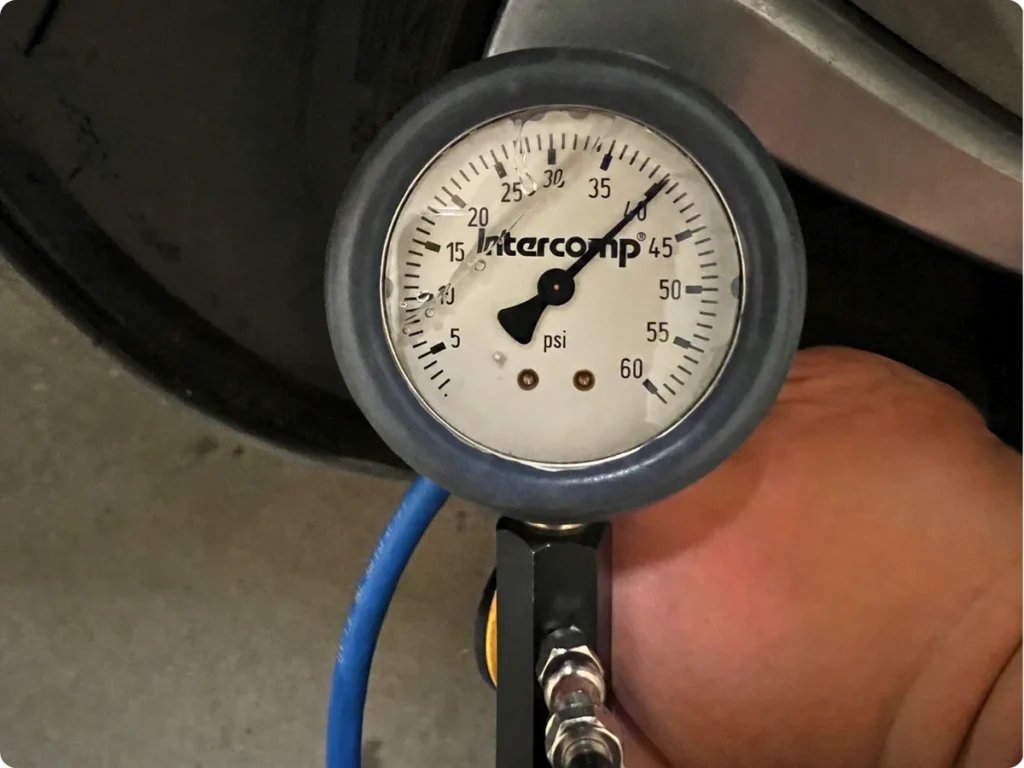
The unit can display tire pressure without running the pump. Connect the high-pressure hose and switch on the inflator.
That is convenient for quick checks, although I would still keep a separate tire gauge in the vehicle. A second gauge provides a useful reference when a tire behaves unexpectedly or the displayed pressure appears inconsistent.
Threaded-chuck pressure loss
The screw-on chuck provides a secure connection. I found it less likely to loosen while moving around the tire than a poorly fitted clamp-style connector.
The compromise is removal speed. Unscrewing the chuck takes longer, and a brief hiss is normal as the connection separates.
Do not assume that every hiss represents meaningful pressure loss. Check the stabilized tire pressure after removal rather than judging by sound alone.
High-altitude calibration
The DCC020I manual includes a pressure-sensor calibration procedure for use above 5,000 feet. The calibration is not retained after the inflator is switched off, so it must be repeated after restarting the unit.
This is especially relevant to drivers, contractors, and campers who regularly use the inflator in mountain regions.
Battery Runtime and the Best Battery Size
For most owners, a 4.0Ah or 5.0Ah 20V MAX battery offers the best balance between runtime and portability.
A smaller 2.0Ah pack is reasonable for:
- Occasional emergency top-offs
- One passenger vehicle
- Reduced carrying weight
- Light household use
The drawback is less reserve capacity for multiple vehicles, deeper refills, or repeated high-volume inflation.
A 4.0Ah or 5.0Ah battery makes more sense for:
- Multi-car households
- Contractors
- Trailer maintenance
- Camping trips
- Repeated pressure checks
- Mattress and raft inflation
Can a FLEXVOLT battery power the DCC020IB?
Compatible FLEXVOLT batteries can operate on the 20V MAX platform. The larger pack primarily offers additional reserve capacity, not a guaranteed increase in pump speed.
A FLEXVOLT battery also adds weight. Unless that is the pack already available, a standard 20V MAX battery is usually easier to handle for routine vehicle use.
Three Power Options Explained
20V MAX battery power
Battery operation is the strongest reason to buy this inflator.
There is no cord to route around the vehicle, and you can move from one tire to the next without repositioning the car or searching for a nearby outlet.
Existing DEWALT owners receive the best value because they may already own compatible batteries and chargers.
Supplied 12V vehicle power
The integrated 12V cord keeps the inflator useful when:
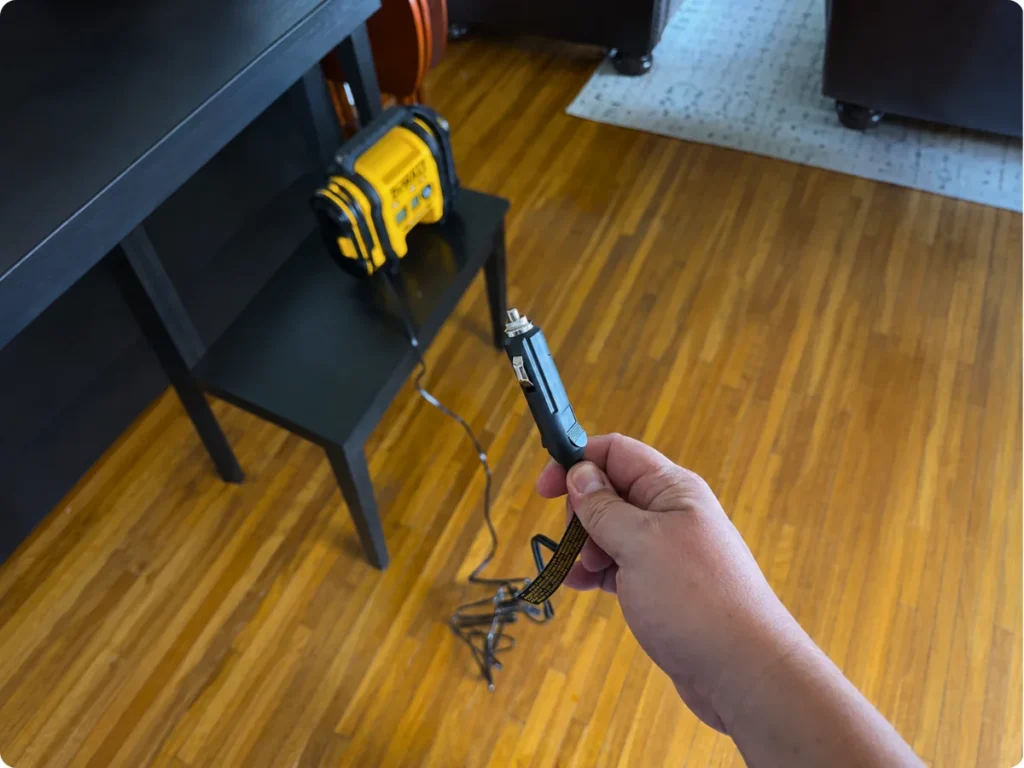
- The cordless battery is discharged
- The battery was left at home
- Several tires require more runtime
- The unit is stored in the vehicle without a battery
The manual identifies the inflator as a 10-amp product. The vehicle outlet and circuit therefore need to support the load. Some accessory outlets only work when the ignition is on, and an undersized or faulty circuit may produce a power error.
Fully extend the cord during operation and inspect the plug and outlet if the unit stops unexpectedly.
Optional household AC power
The DCC020IB supports household AC operation, but the required power supply is separate.
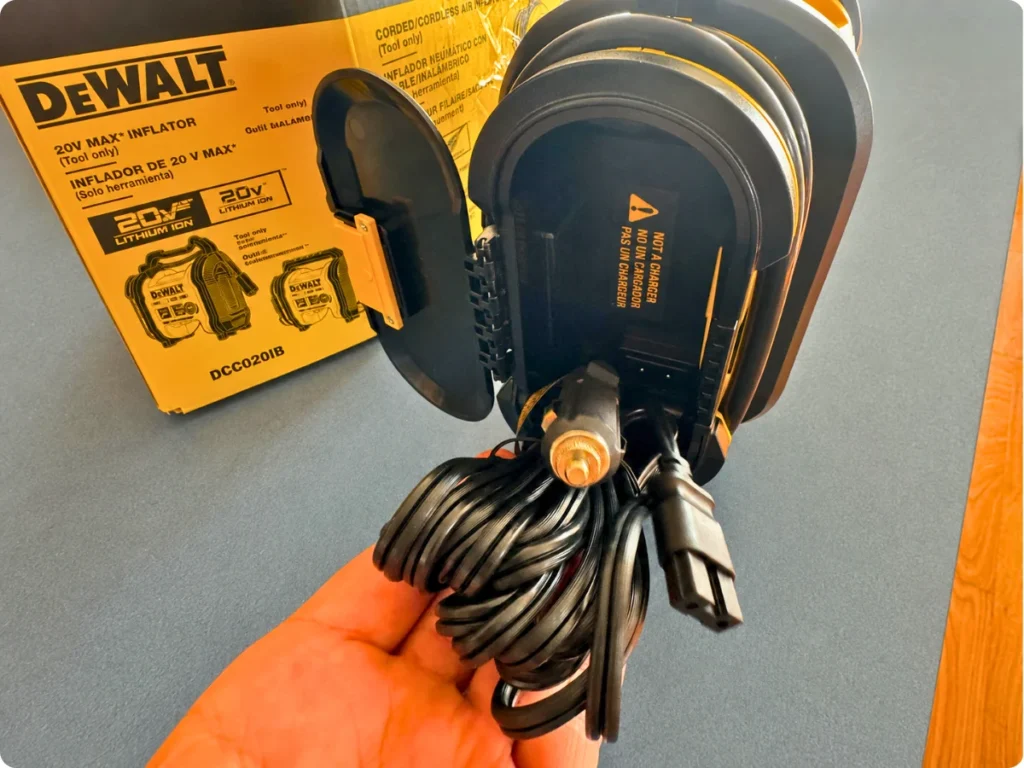
That can be useful for stationary garage use, although it is the least straightforward power option because the adapter is not normally included. I would not buy the DCC020IB solely for wall-outlet operation. Battery and 12V flexibility are much stronger reasons to choose it.
| Situation | Best power source |
|---|---|
| Roadside top-off | 20V MAX battery |
| Battery unavailable | 12V vehicle cord |
| Routine garage use | Battery |
| Stationary use | Optional AC supply |
| Camping | Battery with 12V backup |
| Several household vehicles | 4.0Ah or 5.0Ah battery |
High-Volume Inflation and Deflation
The high-volume system is what separates the DCC020IB from many cordless tire inflators.
Instead of forcing a small amount of air to high pressure, this mode moves a larger amount of air for low-pressure items such as:
- Air mattresses
- Rafts
- Pool floats
- Inflatable toys
- Similar camping equipment
During use, the high-volume hose was much more practical for a mattress than the narrow tire hose. The connection can also be moved to the deflation port, allowing the pump to pull air out before the item is packed.
Why high-volume mode does not stop automatically
Automatic shutoff only applies to high-pressure operation.
Mattresses and rafts do not provide the same controlled pressure feedback as tires, and acceptable firmness varies by design. High-volume mode therefore keeps running until the user stops it.
Stay near the inflatable and monitor its shape and firmness. Do not leave the pump operating unattended.
What high-volume mode cannot replace
The DCC020IB is not intended to function as:
- A shop air compressor
- A pneumatic-tool supply
- A compressed-air cleaning gun
- A paint-sprayer compressor
- A universal paddleboard pump
Inflatable paddleboards may require specialized valves and a higher finishing pressure than the high-volume system is designed to provide.
Controls, Portability, and Practical Use
Digital controls
The controls are easy to understand once you distinguish between the two pump modes.
For tire inflation, the adjustment knob is more convenient than repeatedly pressing small plus-and-minus buttons. The display is easy to read in normal garage conditions, and the separate start/pause control allows inflation to be interrupted quickly.
The selected target is lost when the inflator is switched off. That is less convenient than pressure-memory slots, but it also reduces the chance of accidentally applying an old setting to a different item.
Threaded tire chuck
The threaded chuck favors security over speed.
Its advantages include:
- Firm attachment
- Reliable sealing
- Reduced risk of accidental disconnection
- Hands-free operation after setup
Its disadvantages include:
- Slower connection
- Slower removal
- More awkward use with gloves
- Limited access around deeply recessed valve stems
I prefer its secure fit for automatic inflation, but someone making frequent rapid connections may favor a lever-style chuck.
LED work light
The built-in light helps locate a valve stem beside a dark road or in a poorly lit garage.

It is not a replacement for a proper flashlight, but it illuminates the immediate working area well enough to make the connection easier.
Onboard storage
The hoses, vehicle cord, and small adapters all have dedicated storage positions.
That keeps the DCC020IB relatively organized as a complete system. Make sure the small adapters are pressed securely into their clips before carrying the unit in a truck bed or crowded toolbox.
Size, noise, and heat
The DCC020IB is better suited to a trunk, SUV cargo area, truck toolbox, or garage cabinet than a glovebox.
Like most compact high-pressure inflators, it produces a sharp mechanical sound. The housing can also become warm during demanding inflation.
The manual includes operating and cooling guidance, including limits for certain high-pressure applications. Allow the unit to cool before placing it in a sealed case or hot vehicle compartment.
Buyers who prioritize compact storage should also compare the Fanttik X10 Pro review, GOOLOO A3 review, and AstroAI AIRUN H review.
What Can the DEWALT DCC020IB Inflate?
| Application | Suitability | Important qualification |
|---|---|---|
| Passenger-car tires | Very good | Best for routine checks and top-offs |
| SUV tires | Very good | Larger tires require more time |
| Pickup tires | Good | Better for maintenance than repeated deep refills |
| Trailer and RV tires | Conditional | Consider pressure, volume, heat, and runtime |
| Bicycle tires | Good | Schrader and Presta support |
| Sports balls | Good | Use the included inflation needle |
| Mattresses and rafts | Very good | Use high-volume mode |
| Pool floats | Very good | Monitor manually |
| Paddleboards | Limited | Valve and finishing-pressure requirements vary |
DEWALT DCC020IB Error Codes and Troubleshooting
The manual identifies six main error displays: LoP, bLo, bAt, Er S, OL, and OP. They relate to power supply, battery condition, temperature, sensor faults, restrictions, or excessive pressure.
| Code | Meaning | First action |
|---|---|---|
| LoP | Vehicle or external-supply voltage problem | Check the outlet or power source |
| bLo | Battery discharged | Recharge or replace the battery |
| bAt | Battery too hot or too cold | Let it return toward room temperature |
| Er S | Pressure-sensor fault | Contact an authorized DEWALT service center |
| OL | Excessive pump current or airflow restriction | Inspect the hose, valve, and connections |
| OP | Excess-pressure condition | Check for a blocked hose or connection |
The display reads Er S, not “Error 5.” Segmented characters can be misread, which explains the incorrect label found in some unofficial guides.
Inflator will not turn on
Check the simplest causes first:
- Confirm the battery is charged.
- Remove and reseat the battery.
- Try another compatible battery.
- Inspect the 12V plug and vehicle outlet.
- Check the vehicle’s accessory-outlet fuse.
- Confirm that any AC supply is compatible.
- Let a very hot or cold battery return toward room temperature.
Inflator stops before reaching the target pressure
Possible causes include:
- Low battery charge
- Battery-temperature protection
- Restricted hose
- Poor valve connection
- Weak or unsuitable 12V power
- Excessive pump load
- Pressure-sensor fault
Disconnect and inspect the hose before repeatedly restarting the unit.
Inflator stops at the wrong pressure
Let the reading stabilize and compare it with a separate gauge.
Also check:
- Chuck seating
- Tire-valve condition
- Hose restrictions
- High-altitude calibration
- Whether the error repeats under the same conditions
A consistent pressure-sensor problem requires service rather than an improvised repair.
DEWALT DCC020IB vs Other Tire Inflators
DEWALT DCC020IB vs Milwaukee M18 2848-20
Choose the DEWALT for versatility; choose the Milwaukee when tire inflation is the main job.
| Feature | DEWALT DCC020IB | Milwaukee 2848-20 |
|---|---|---|
| Battery platform | DEWALT 20V MAX | Milwaukee M18 |
| Main focus | Tires and high-volume inflatables | Passenger and light-truck tires |
| 12V vehicle power | Yes | No |
| Optional AC operation | Yes | No |
| High-volume inflation | Yes | No |
| Deflation | Yes | No |
| Automatic tire shutoff | Yes | Yes |
| Pressure memories | No | Four |
| Best buyer | Multi-purpose user | Tire-focused user |
Milwaukee rates the 2848-20 to 150 PSI, includes four pressure-memory slots, and uses TrueFill technology to pause, check stabilized pressure, and continue filling when needed. Milwaukee positions it for passenger, light-truck, and other medium-duty tires.
The DEWALT is the better choice for camping equipment, vehicle-power backup, and mixed household use. The Milwaukee is more appealing when speed and tire-specific controls matter most.
Read the Milwaukee M18 2848-20 review or our full Milwaukee M18 2848-20 vs DEWALT DCC020IB comparison for a closer look.
DEWALT DCC020IB vs CRAFTSMAN CMCE520B
The CRAFTSMAN CMCE520B is the closest direct alternative because it also supports battery, 12V vehicle, and AC operation. CRAFTSMAN describes it as a tool-only V20 inflator that can handle jobs ranging from an air mattress to an automobile tire.
For most buyers, the existing battery platform should control the decision. Choose the DEWALT when you already own 20V MAX batteries. Choose the CRAFTSMAN when you are invested in V20 and prefer to stay within that system.
See the CRAFTSMAN CMCE520B review for the full ownership comparison.
DEWALT DCC020IB vs VIAIR 88P
The VIAIR 88P takes a more vehicle-focused approach. It connects to the vehicle battery rather than relying on a cordless tool pack.
VIAIR is better suited to buyers who prioritize roadside tire work and do not need mattress inflation or deflation. The DEWALT is more convenient to carry between tires and more useful around the house or campsite.
Rechargeable alternatives
The ETENWOLF Vortex S6 review and NOCO AIR20 review are worth considering when you prefer a self-contained rechargeable inflator rather than a power-tool battery platform.
Owner Feedback, Warranty, and Reliability
The most consistent reasons owners like the DCC020IB are:
- Automatic shutoff
- Cordless convenience
- DEWALT battery compatibility
- 12V backup power
- High-volume inflation
- Integrated accessory storage
- Roadside usefulness
Recurring complaints tend to involve:
- Confusion about the optional AC supply
- Battery or power errors
- Threaded-chuck inconvenience
- Slower performance on larger tires
- Pressure-sensor faults
- Inconsistent retailer specifications
Owner comments are useful for identifying repeated themes, but one failed unit does not prove a universal defect. Shipping damage, returned products, incorrect bundles, and unrealistic expectations can also affect retailer reviews.
DEWALT lists a three-year limited warranty for covered products and provides factory and authorized service support.
Is the DEWALT DCC020IB Worth It?
It is worth it for existing DEWALT owners
This is the easiest recommendation.
When compatible batteries and a charger are already available, the DCC020IB gives you:
- Cordless tire inflation
- Automatic shutoff
- 12V backup
- High-volume inflation
- High-volume deflation
- Bicycle and sports-ball accessories
- Integrated storage
That combination is difficult to replace with a small tire-only pump.
It is a more complicated purchase for new users
A first-time DEWALT buyer must consider the full cost:
- Bare tool
- Battery
- Charger
- Optional AC supply
- Storage or carrying solution
A self-contained rechargeable inflator may cost less and occupy less space. The DCC020IB becomes worthwhile when you will genuinely use its 12V backup, high-volume hose, or DEWALT battery compatibility.
When another inflator is better
Choose another model when:
- You regularly fill large tires from very low pressure
- You need the fastest possible cordless tire performance
- You want a glovebox-sized emergency pump
- You prefer an internal rechargeable battery
- You do not need high-volume inflation or deflation
- You need sustained commercial compressor duty
Final Verdict
The DEWALT DCC020IB does not earn its recommendation by being the smallest or most tire-focused inflator. It earns it by handling more jobs than most competing cordless models.
Its combination of 20V MAX battery power, supplied 12V backup, automatic tire shutoff, high-volume inflation, deflation, onboard storage, and an LED work light makes it particularly useful for drivers, contractors, campers, and homeowners already invested in DEWALT batteries.
The missing battery and separate AC supply are meaningful drawbacks. It is also bulkier than compact emergency pumps, and frequent large-truck-tire work may justify a faster or heavier-duty alternative.
For an existing DEWALT 20V MAX owner, the DCC020IB is an easy recommendation. For someone starting without batteries, it is worth the additional cost only when the power flexibility and high-volume capability will be used.
Frequently Asked Questions
Does the DEWALT DCC020IB include a battery and charger?
Can the DCC020IB plug into a wall outlet?
What battery size is best for the DEWALT inflator?
Can a FLEXVOLT battery power the DCC020IB?
Can it inflate truck, trailer, or RV tires?
Editorial Transparency
This review combines practical product evaluation, engineering knowledge, official documentation, manufacturer specifications, recurring owner-feedback patterns, and editorial analysis. Specifications describe documented capability, while practical observations explain normal ownership and usability.


Engr. Hm Jamal, founder of Wits Engineer, is a home appliance and water systems specialist with 13+ years of hands-on experience in electrical work, home improvement, and water treatment. A BUET-trained Electrical Engineer, he focuses on how appliances and filtration systems perform in real homes—not just in ideal tests. His reviews highlight practical usability, maintenance needs, energy behavior, and safety limits to help readers avoid products that fail in long-term use. Alongside fieldwork, he creates experience-based guides and training content to help homeowners and professionals make smarter, safer decisions about water and home systems.
