Fast charging, practical backup.

Anker SOLIX C1000 Gen 2

8.1/10
Good
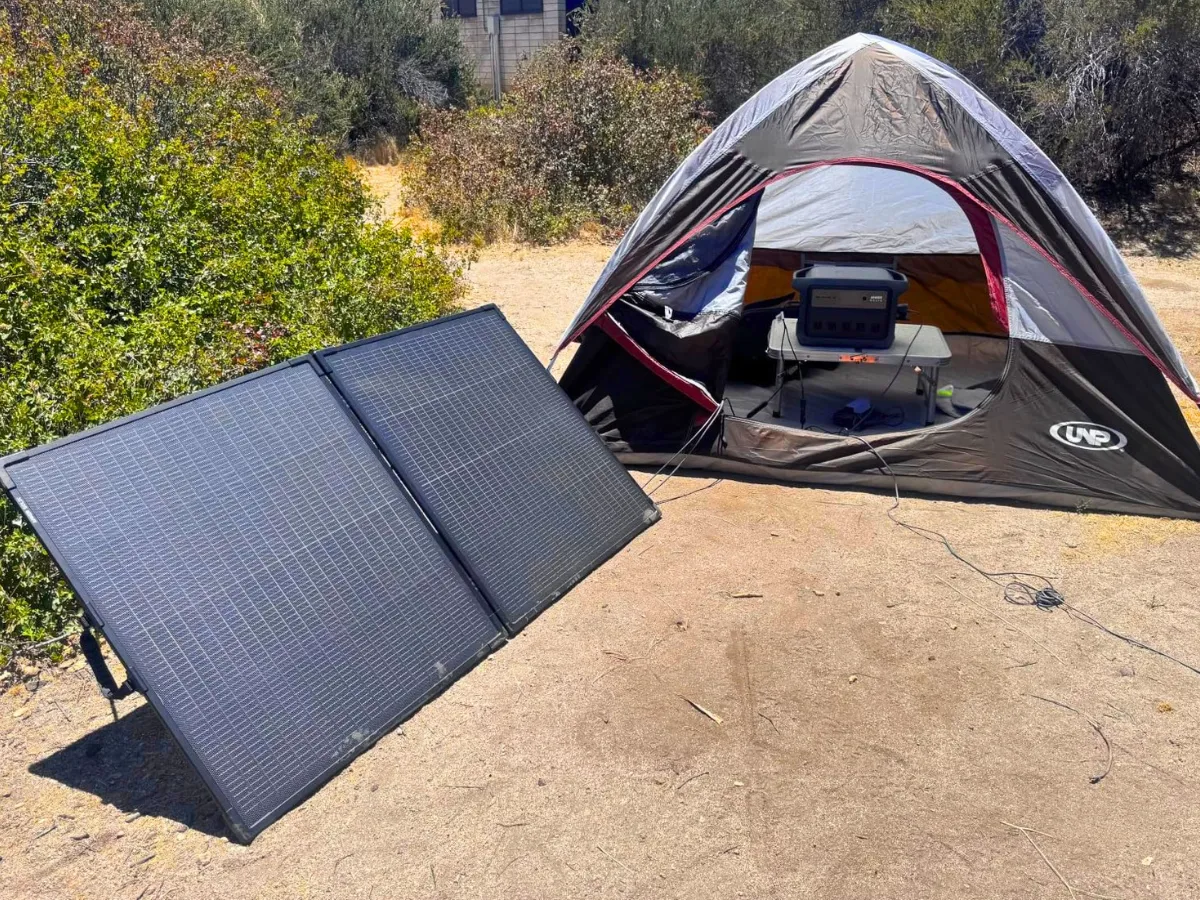
Anker SOLIX C1000 Gen 2 on a camping table inside a tent, with a folding solar panel outside

These serve the most different needs: Anker favors transport, while Apex favors a larger stationary arrangement.

Apex offers substantially more nominal storage and higher rated output, but its tested weight was more than three times Anker’s. If you mainly need laptop power, networking, and occasional cooking tasks while traveling, carrying that additional system may offer little practical benefit.

Anker sustained a combined 1,698W load for 25 minutes without shutdown. It also ran a separate 23W router-and-modem setup for 22.8 hours. Those results illustrate its usefulness for selected loads without requiring a large backup installation.

Apex becomes more relevant when Anker’s fixed storage, 120V configuration, or output capability cannot meet the intended requirements. Compatible expansion batteries provide a route to additional stored energy, although they add cost and handling demands.

The charging records reflect different setups: Anker reached displayed 100% from 0% in 59 minutes using Standard mode; Apex charged from 1% to 100% in 2 hours 31 minutes on a 120V supply. These figures describe the tested experience, rather than a controlled charging-efficiency comparison.

Our recommendation: Choose Anker when you expect to carry the station frequently. Choose Apex when your equipment and future storage requirements justify a mostly stationary, expandable system.

Usable energy and runtime
7.5/10
Good
AC output and appliance compatibility
8.0/10
Good
Recharging performance
9.2/10
Excellent
Portability and handling
9.5/10
Excellent
Noise
8.0/10
Good
Ports, controls, and backup operation
8.5/10
Good
Expansion and system flexibility
6.0/10
Adequate
View measured results
MeasureResultConditions
Usable AC capacity855–891WhThree continuous loads: 52W, 248W, and 1,015W
High-load runtimeApproximately 52 minutes1,015W average load; 75°F
Router and modem runtime22.8 hours23W average combined AC load
Standard AC charging59 minutesDisplayed 0–100%; Standard mode
Sustained appliance load1,698W for 25 minutesCooktop, workstation, and network equipment; no shutdown
Included-panel solar charging45% to 60% displayed charge in one hourSingle 200W Anker panel; clear sky; no output loads; 162W peak displayed input
Charging noise35.1–41.2 dBA600W charging versus Standard charging; 1 meter; 31.2 dBA background
View features and specifications
Rated continuous AC output
2,000W total; U.S. 120V/60Hz
Advertised peak output
3,000W; not independently measured
Purchased bundle
Power station plus one Anker 200W solar panel
Measured station weight
24.85 pounds / 11.27kg
Measured station dimensions
15.1 × 8.2 × 9.6 inches
Rated battery capacity
1,024Wh LiFePO4 / LFP

Reasons to buy

  • Standard charging reached displayed 100% in 59 minutes.
  • Delivered useful energy across three AC load levels.
  • Sustained a demanding multi-device setup without shutdown.
  • Included 200W panel raised displayed charge by 15 percentage points in one clear-sky hour.

Reasons to consider another

  • No expansion-battery support.
  • High-power appliances shorten runtime substantially.
  • Faster charging brings more noticeable fan noise.
  • Bulky adapters can obstruct adjacent AC outlets.

BLUETTI Elite 200 V2

8.0/10
Good
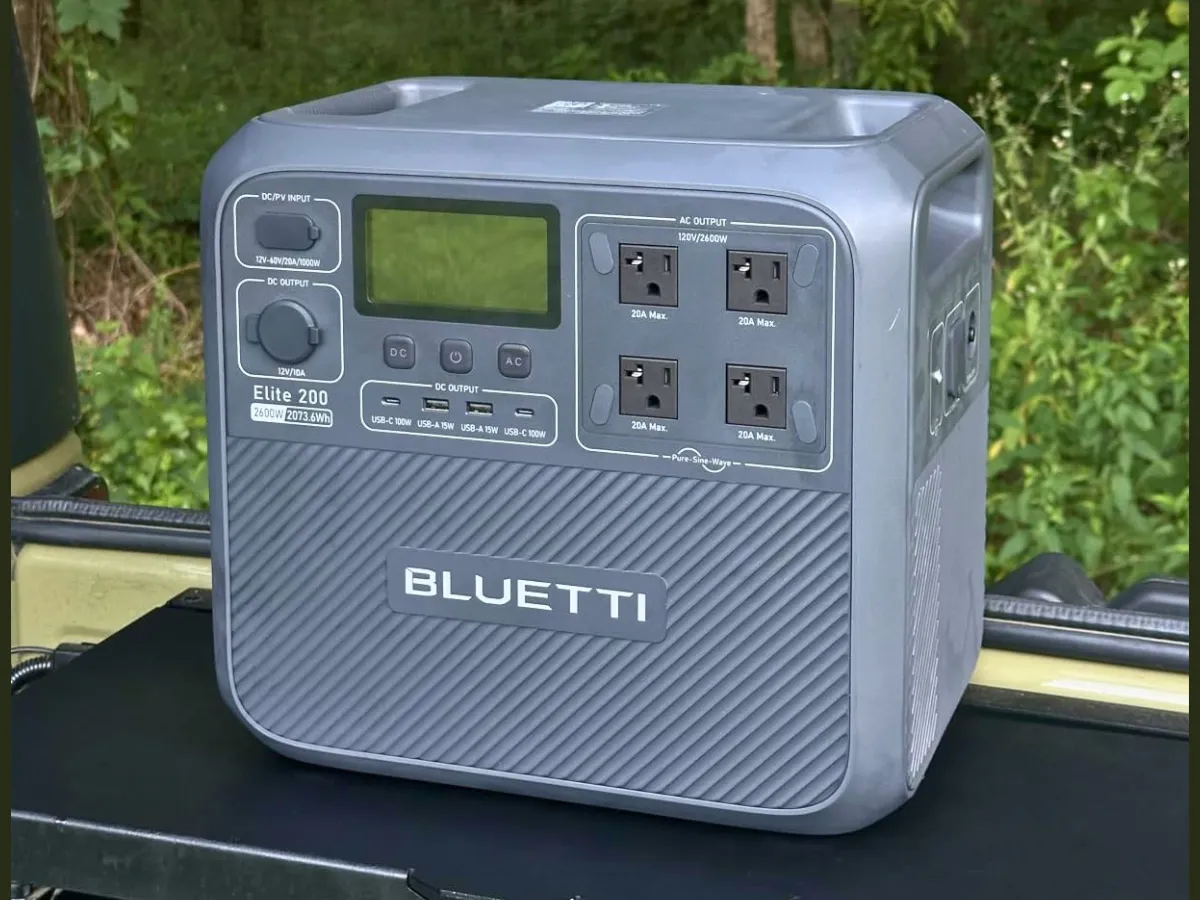
Featured image for Grow Gadget’s BLUETTI Elite 200 V2 review, covering usable capacity, refrigerator runtime, AC charging, solar input, and noise.

Choose Anker for mobility; choose Elite for more appliance power and energy between charges.

The Anker weighed 24.85 pounds, compared with approximately 53.4 pounds for Elite. That difference matters when loading a vehicle, moving between rooms, or carrying the station to a campsite. Anker is the more manageable option when movement is part of regular use.

Elite’s additional weight brings a larger battery and higher output rating: 2,073.6Wh and 2,600W, compared with Anker’s 1,024Wh and 2,000W. These are manufacturer specifications, but the recorded tests also demonstrate their different roles.

Anker delivered 880Wh at a 1,015W average load, running for approximately 52 minutes. Elite’s approximately 1,000W discharge records show 1,760–1,949Wh delivered. These were separate tests rather than a matched trial, but they support choosing Elite when more energy between charges matters.

Anker completed its Standard recharge in 59 minutes, while Elite reached full charge in approximately 84 minutes using Turbo mode. Anker finished sooner in the recorded runs; Elite replenished a substantially larger battery.

Our recommendation: Choose Anker for electronics, trips, and shorter appliance tasks with regular charging opportunities. Choose Elite when backup duration and substantial appliance demand justify the heavier station. Neither offers supported battery expansion.

Usable energy and runtime
8.0/10
Good
AC output and appliance compatibility
9.0/10
Excellent
Recharging performance
9.0/10
Excellent
Portability and handling
6.5/10
Adequate
Noise
8.0/10
Good
Ports, controls, and backup operation
8.5/10
Good
Expansion and system flexibility
7.0/10
Good
View measured results
MeasureResultConditions
Usable AC energy1,760–1,949WhApproximately 1,000W resistive load; charging disconnected
Low-load runtime29–31 hoursContinuous 50W AC load; ECO off
Moderate-load runtime8.5–8.8 hoursContinuous 200W AC load; ECO off
Refrigerator runtime25 hours, 20 minutes27 cu. ft. LG refrigerator; 70–72°F; normal door use
AC output2,500–2,600WCombined load across AC outlets
Turbo rechargeApproximately 66 minutes to 80%; 84 minutes to fullStarting at displayed 0%
Operating noise44–49 dB(A)Heavy-use testing; measured at 1 metre
View features and specifications
USB ports
Two 100W USB-C ports and two 15W USB-A ports.
Charging
AC charging up to 1,800W; solar input up to 1,000W within 12–60V and 20A limits
Controls
Wi-Fi/Bluetooth app connection, charging profiles, ECO settings, and UPS modes
Portability
53.4 lb, with two carrying handles.
Warranty
Five years under the applicable US warranty terms.
Rated battery capacity
2,073.6Wh LiFePO4 capacity
Continuous AC output
Four 120V outlets sharing 2,600W total, with a pure sine wave inverter
Vehicle-style DC outlet
One 12V/10A vehicle-style socket
Battery expansion
No supported expansion-battery connection.
Battery
2,073.6Wh LiFePO4 capacity
AC output
Four 120V outlets sharing 2,600W total, with a pure sine wave inverter
DC outlet
One 12V/10A vehicle-style socket
Expansion
No supported expansion-battery connection.

Reasons to buy

  • Handles substantial AC loads, with 2,500–2,600W recorded in output testing.
  • Delivered approximately 29–31 hours at a steady 50W load.
  • Completed the recorded refrigerator run in 25 hours and 20 minutes.
  • Reached full charge in approximately 84 minutes using Turbo mode.
  • Supplied two USB-C loads at 100W each during simultaneous-port testing.

Reasons to consider another

  • Approximately 53.4 pounds makes regular transport demanding.
  • AC inverter idle consumption reduces efficiency during prolonged light use.
  • No supported expansion-battery connection to increase its stored capacity.
  • Its transfer capability does not make it a substitute for a dedicated high-performance UPS.

BLUETTI Apex 300

7.3/10
Good
BLUETTI Apex 300 portable power station on a wooden workbench with its display illuminated

Choose Elite for a simpler fixed-capacity setup; choose Apex when expansion or 240V capability is essential.

Elite combines substantial AC output with direct USB-C, USB-A, and vehicle-style DC connections. The review recorded two USB-C loads operating at 100W each simultaneously. Apex’s direct USB/DC connectivity requires additional equipment, making it less convenient for a mixed collection of small devices.

Apex offers capabilities Elite lacks: documented battery expansion and simultaneous 120V/240V operation. Its nominal battery capacity is also larger at 2,764.8Wh, compared with Elite’s 2,073.6Wh.

Higher rated output needs context. Apex is rated for 3,840W and maintained 3,470W for 40 minutes in the recorded observation. However, a separate 3,800W run stopped after 18 minutes, with the cause unconfirmed. Elite recorded operation at 2,500–2,600W. These findings support different appliance demands without establishing that either station will operate every load within its advertised rating indefinitely.

Handling is another major difference. Elite is already substantial at approximately 53.4 pounds; the tested Apex weighed 84.6 pounds.

Our recommendation: Choose Elite when its fixed storage and output meet your requirements. Choose Apex when you specifically need its expansion path or voltage flexibility and can accommodate the weight, accessories, and operating headroom.

Usable energy and runtime
8.0/10
Good
AC output and appliance compatibility
7.0/10
Good
Recharging performance
7.5/10
Good
Portability and handling
5.5/10
Adequate
Noise
7.0/10
Good
Ports, controls, and backup operation
7.0/10
Good
Expansion and system flexibility
9.0/10
Excellent
View measured results
MeasureResultConditions
Usable AC capacityApproximately 2,480WhContinuous 2,000W load; 240V mode; 22°C
Light-load runtime35 hours 7 minutesApproximately 58W; 120V mode; ECO disabled; 22°C
Sustained output3,470W for 40 minutes120V mode; 23°C; no observed output reduction
AC recharge time2 hours 31 minutesDisplayed 1–100%; 120V household supply; Standard mode
Medium-load usable AC energyApproximately 2,480Wh2,000W; 240V; 22°C; standalone unit
Backup continuityNo observed reboot or interruptionTested workstation computer and router when grid power was disconnected
Operating noise39.4dBA charging; 51.8dBA under loadSilent charging / 3,500W output; three feet; 31.2dBA background
View features and specifications
Battery capacity
2,764.8Wh LiFePO₄ (LFP) battery
Continuous AC output
3,840W total
Dual-voltage operation
Simultaneous 120V/240V capability
AC outlets
Four household outlets, one TT-30R, and one 14-50R; shared output limits apply
Expandable storage
Compatible with BLUETTI B300K and B500K expansion batteries
Solar charging
Two inputs supporting up to 2,400W combined; compatible panels required
UPS functionality
Manufacturer-specified 0ms or 20ms operation, depending on configuration
Controls and connectivity
Physical controls, LCD display, Bluetooth, and Wi-Fi app access

Reasons to buy

  • Approximately 2,425–2,480Wh of recorded usable AC energy at medium and high loads.
  • Maintained 3,470W for 40 minutes without observed output reduction.
  • Simultaneous 120V/240V capability from one main unit.
  • The tested computer and router continued operating when grid power was removed.
  • Compatible expansion batteries offer a path to longer runtime.

Reasons to consider another

  • Our unit weighed 84.6 lb.
  • AC output stopped after 18 minutes at 3,800W.
  • Direct USB/DC connections require additional equipment.
  • Delivered-energy yield was lower during extended light-load operation.
  • Batteries, hubs, and installation equipment add to the purchase cost.

Conclusion

For frequent carrying and quick replenishment, choose the Anker SOLIX C1000 Gen 2. For substantial plug-in appliance backup without battery expansion, choose the BLUETTI Elite 200 V2. For expandable storage and simultaneous 120V/240V capability, consider the BLUETTI Apex 300.

The deciding question is whether you need easier transport, more energy in a fixed-capacity unit, or a system that can expand. Match that requirement first, then use the Compare tab to check the measurements, features, and individual scores that matter to your equipment.

Engineer Md Jamal

ABOUT THE AUTHOR

Engineer Md Jamal

Engr. Md Jamal is an "Electrical Engineer" with more than 13 years of experience in appliance performance. As the founder of Wits Engineer, the publication covers Power & Energy, Living, Cleaning, Electronics, and Kitchen.

View author profile

Guide updates

We aligned the three reviews under one editorial scoring framework and updated this comparison around their different buyer roles. Anker and Elite each score 8.0/10, while Apex scores 7.3/10. Existing measurements remain unchanged.