 Product guides. Clear decisions.
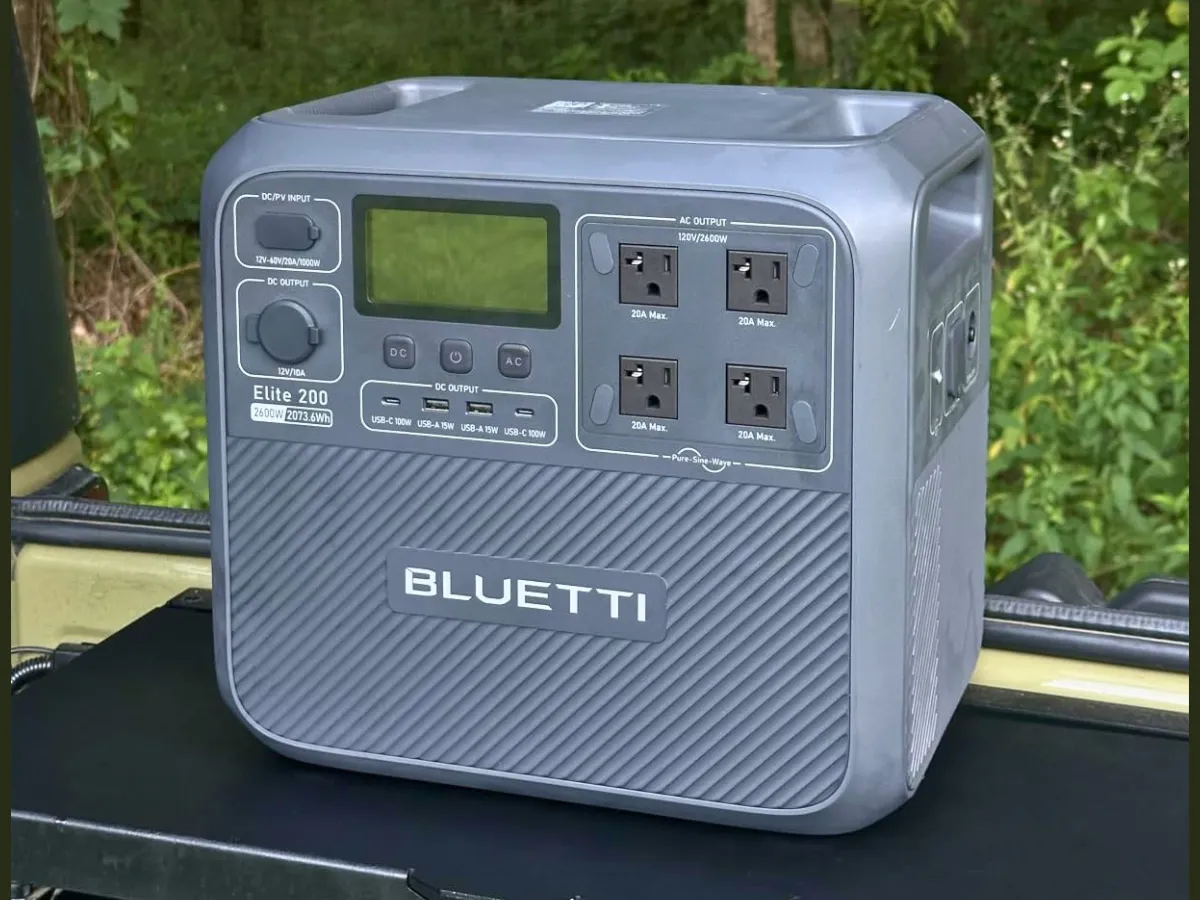
This BLUETTI Elite 200 V2 review focuses on a practical question: can a roughly 2kWh portable power station keep essential appliances running long enough to be useful during an outage? Our refrigerator test lasted 25 hours and 20 minutes, while Turbo charging restored the displayed charge to 100% in approximately 84 minutes.
Its 2,073.6Wh lithium iron phosphate battery, also called LiFePO4 or LFP, supplies a rated 2,600W pure sine wave inverter. Capacity determines how long a load can run; output determines which appliances it can operate. A heater can fit within the output limit yet exhaust the battery much sooner than a cycling refrigerator.
For a household that can keep the station near its main appliances, that combination works well. The limitations are equally practical: it weighs about 53 pounds, consumes energy while the AC inverter is idle, and cannot accept a supported expansion battery. This review covers the US 120V version.
Measured results
| Measure | Result | Conditions |
|---|---|---|
| Usable AC energy | 1,760–1,949Wh | Approximately 1,000W resistive load; charging disconnected |
| Low-load runtime | 29–31 hours | Continuous 50W AC load; ECO off |
| Moderate-load runtime | 8.5–8.8 hours | Continuous 200W AC load; ECO off |
| Refrigerator runtime | 25 hours, 20 minutes | 27 cu. ft. LG refrigerator; 70–72°F; normal door use |
| AC output | 2,500–2,600W | Combined load across AC outlets |
| Turbo recharge | Approximately 66 minutes to 80%; 84 minutes to full | Starting at displayed 0% |
| Operating noise | 44–49 dB(A) | Heavy-use testing; measured at 1 metre |
Review scores
Equal average: 8.071/10. Displayed as 8.1/10.
Review approach and evidence
We evaluated the Elite 200 V2 through hands-on capacity, appliance, charging, transfer, and connection tests. Manufacturer ratings establish nominal capacity and operating limits; measured results show how the station behaved under the conditions described here. The evaluation covers battery discharge, appliance operation, AC charging, transfer interruptions, ports, and solar-input behavior. Battery cycle life and warranty are manufacturer claims and terms; this review does not present them as independently completed endurance tests. Delivered AC energy divided by nominal battery capacity is a capacity-utilization ratio. Measuring inverter efficiency alone would require battery-side energy measurements as well, so no isolated inverter-efficiency percentage is assigned here.
How we test
Capacity testing uses a charged station with all charging inputs disconnected. A measured load runs until automatic output cutoff, with delivered AC energy and elapsed time recorded. Low-load tests use separate 50W and 200W loads with AC ECO disabled.
The refrigerator test records the appliance type, room temperature, and door-opening pattern because compressor cycling changes consumption over time. Output testing checks the total connected load alongside voltage and frequency.
Charging evaluation records displayed charge level, elapsed time, and wall energy. Transfer testing captures the output interruption during grid loss and restoration, while port testing checks simultaneous loads rather than relying on a connector's printed rating.
Results are interpreted within those conditions. A successful appliance start establishes compatibility with that appliance and setup; it does not establish a universal motor-starting limit.
How It Compares With Our Other Power Station Picks
Model
Nominal capacity
Rated AC output
Main difference
BLUETTI Elite 200 V2 [TESTED]
2,073.6Wh
2,600W
Strong rated output; fixed battery capacity; 53.4 lb
EcoFlow DELTA 2 Max [RESEARCH]
2,048Wh
2,400W
Supports expansion to 6,144Wh with two compatible extra batteries
Jackery Explorer 2000 v2 [RESEARCH]
2,042Wh
2,200W
Approximately 39.5 lb; lower rated output
Competitor figures are manufacturer specifications, not results from our test bench. Sources: EcoFlow DELTA 2 Max and Jackery Explorer 2000 v2.
Against the EcoFlow DELTA 2 Max, the BLUETTI offers a higher rated AC output but gives up an expansion path. Choose the expandable approach if you expect your stored-energy needs to grow. Against the Jackery Explorer 2000 v2, the main trade-off is carrying weight: the Jackery is about 14 pounds lighter, while the BLUETTI has the higher rated output. These specification differences do not establish which competitor delivers more usable energy or runs quieter.
Our detailed review
Usable capacity matters more than the battery label
The Elite 200 V2 delivered 1,760–1,949Wh in the approximately 1,000W discharge records, equivalent to about 85–94% of nominal capacity. For a buyer, the delivered Wh figure matters because it represents energy available to an appliance after the system has consumed its share.
Use the lower end when building a cautious outage plan. As an illustration, a steady 1,500W heater would calculate to roughly 70–78 minutes using that energy range. That is an estimate based on another load condition, not a measured heater runtime, but it explains why high output does not necessarily mean all-night heating.
At 50W, delivered energy was approximately 1,450–1,550Wh and runtime reached 29–31 hours. At 200W, delivered energy rose to approximately 1,700–1,760Wh, producing 8.5–8.8 hours. Light loads run longer, allowing inverter overhead to accumulate for more hours; the station does not deliver one fixed AC energy figure at every load.
Refrigerator backup is a strong practical use
The recorded LG refrigerator ran for 25 hours and 20 minutes in a 70–72°F room with approximately 15–20 daily door openings. That is a useful result for a household planning around an overnight outage and the following day.
A separate owner account reported approximately 17 hours with a different refrigerator setup. The difference is a useful reminder to assess your own appliance’s energy use, room temperature, and door-opening pattern before planning around a full day of backup.
The supplied refrigerator energy range of 1,600–1,770Wh would average approximately 63–70W over that runtime. Compressor cycling makes the average much lower than some instantaneous readings. For backup planning, energy consumed across a representative day is more informative than one reading while the compressor is running.
Strong output expands the appliance options
The station handled recorded loads of 2,500–2,600W, with output readings of 119.5–120.4V at 60.0Hz. That makes its output capability a major strength for appliances whose running demand would overwhelm a smaller station.
However, 2,600W is the total AC rating across the outlets. It is not available separately from each socket. Appliance combinations must be assessed by their combined demand, including starts where relevant.
The table saw and commercial blender were included in motor-start testing, which recorded 10 successful starts out of 10 attempts and transient demand of approximately 2,800–3,400W. Those results support the tested combination of appliance and conditions; a different compressor or tool can have a different starting demand.
Power Lifting trades heating output for compatibility
BLUETTI's Power Lifting feature supports suitable resistive appliances with nameplate ratings above the normal AC output limit. Its documented 3,900W appliance figure does not mean the station delivers 3,900W of normal AC power.
In the Power Lifting test, a resistive heating setup remained energized with reduced voltage and heating output. The practical benefit is continued operation, though a heating task may take longer.
Keep Power Lifting disabled when evaluating normal-voltage output. Its reduced-voltage operation is intended for suitable resistive heating appliances, so it should not be used to infer compatibility with sensitive electronics or motor loads.
Turbo charging is a meaningful strength
The recorded Turbo run reached 80% in approximately 66 minutes and displayed 100% after about 84 minutes. That is valuable when a short period of grid access must replenish the station before another outage.
The depleted-to-full Turbo recharge used approximately 2,320Wh from the wall. That is the energy to budget for replenishing the station under those conditions; it should not be confused with the AC energy subsequently available at its outlets.
The three charging profiles let you balance replenishment speed against input demand and fan activity. The US manual lists maximum AC charging inputs of 1,440W in Standard, 1,800W in Turbo, and 800W in Silent mode. Our Silent-mode record reached full charge in approximately 3.1 hours, making it an option when speed matters less than limiting input demand.
Solar charging needs careful panel matching
The solar input is specified for up to 1,000W within a 12–60V, 20A operating envelope. An array's wattage alone is insufficient to establish compatibility: its voltage and current must also suit the station.
MPPT, or maximum power point tracking, adjusts the solar input to follow the array’s available power. In the verified records, initial tracking took approximately 18–25 seconds, and input returned to at least 95% of the prior peak within approximately 12 seconds after shade was removed. These describe the tested setup rather than guaranteed recovery times under every sky condition.
Solar-array nameplate watts are not a promise of actual input. Panel angle, shading, and conditions affect the available power. Match the array’s open-circuit voltage and current to the input limits; reaching a particular wattage is not worth exceeding the voltage ceiling.
Idle losses and fan noise affect daily use
Recorded AC idle draw of 9.5–11.8W calculates to approximately 228–283Wh over 24 hours if maintained continuously. That energy can be significant when the intended load is small.
With only DC enabled, idle power fell to approximately 2.1–2.4W. For compatible USB-C equipment, direct DC operation avoids keeping the AC inverter running solely for an adapter. Disable AC ECO when powering low-draw equipment that must remain on; cycling appliances can otherwise encounter an unwanted automatic shutdown.
Heavy-use sound levels were approximately 44–49 dB(A) at 1 metre. Expect audible cooling during demanding use, and position it with that in mind if it shares a quiet room. A single heavy-use range cannot predict every charging mode or fan stage.
USB-C flexibility is useful; carrying weight is harder to overlook
Both USB-C Power Delivery ports sustained 100W simultaneously, with approximately 19.8–20.1V measured under load. This is useful for two compatible laptops or other high-demand USB-C devices. The vehicle-style outlet is officially rated 12V/10A; approximately 13.6V was observed in the supplied test, which should be treated as a measured operating value.
The larger practical compromise is the approximately 53.4-pound chassis. Two handles help with lifting, but moving it repeatedly between rooms, vehicles, and storage remains a substantial task. It makes more sense as equipment positioned near its main backup load than as something carried around throughout the day.
Transfer performance has a defined scope
Measured interruption during grid failure ranged from 11.2–13.8ms, with approximately 10–12ms recorded on restoration. The connected equipment remained operating during the recorded events.
That establishes a useful compatibility result for the tested setup. BLUETTI nevertheless cautions against using the unit for equipment requiring high-performance UPS protection. Critical servers and workstations should be matched to an appropriate dedicated UPS rather than selected solely from this transfer-time result.
The BLUETTI app connects over Bluetooth or Wi-Fi and provides UPS scheduling and state-of-charge (SoC) controls. Limits in Custom UPS mode should not be assumed to apply identically to solar-only charging. Check the relevant operating mode when setting an upper limit.
Pass-through limits and recovery after depletion
Pass-through operation powers connected equipment while AC input is present, but its limits differ from battery-only output. The US model’s documented 1,800W AC input ceiling includes charging and bypass. Do not plan on a 2,600W bypass load plus full-rate AC charging at the same time.
System Switch Recovery also deserves attention for unattended backup. The US manual describes saved AC/DC states restoring at 5% charge with grid power. Without grid power, it adds a requirement for at least 30 minutes since shutdown. Restoration after an empty battery is therefore different from the brief transfer during an ordinary grid failure.
Battery longevity and ownership
BLUETTI claims more than 6,000 battery cycles to 80% of original capacity. That describes a manufacturer endurance rating, not a promise of unchanged capacity or a lifespan established by this review. See BLUETTI’s cycle-life description.
The US warranty lists 60 months for the Elite 200 V2. Warranty coverage and battery cycle life address different questions: one concerns applicable product support, while the other describes capacity retention under specified cycling conditions. See the official warranty period.
The larger ownership constraint is fixed capacity. You cannot extend backup duration by attaching a supported expansion battery, so size the station for the outage you intend to cover. Extra solar panels may replenish energy when sunlight is available, but they do not add stored energy for the night.
Who Should Buy It—and Who Should Skip It?
Buy it if:
- You want refrigerator backup with enough AC output for substantial household appliances.
- Fast recharging matters during limited periods of grid availability.
- You can position the station close to its main load and move it occasionally.
- You will size your backup expectations around measured runtime rather than nominal capacity alone.
Consider another option if:
- You need equipment that is easy to carry frequently.
- Critical computing requires dedicated high-performance UPS protection.
- Your solar array exceeds the input voltage limit.
- You need an expansion-battery path for longer outages.
Conclusion
The BLUETTI Elite 200 V2 earns 8.3/10 for a useful combination of high AC output, day-long refrigerator backup in the recorded test, and an approximately 84-minute Turbo recharge. It suits a household that needs substantial plug-in appliance power and can keep the station near its main load.
Its fixed capacity matters more than the number of available sockets. Choose it when the measured energy delivery fits your outage plan; look toward an expandable system for longer coverage or a lighter station for frequent carrying. For critical computing, use a dedicated UPS matched to that equipment.
Price and availability
Check the exact model, included accessories, seller, and regional terms.

ABOUT THE AUTHOR
Engineer Md Jamal
Engr. Md Jamal is an "Electrical Engineer" with more than 13 years of experience in appliance performance. As the founder of Wits Engineer, the publication covers Power & Energy, Living, Cleaning, Electronics, and Kitchen.
View author profile